
2020 Review
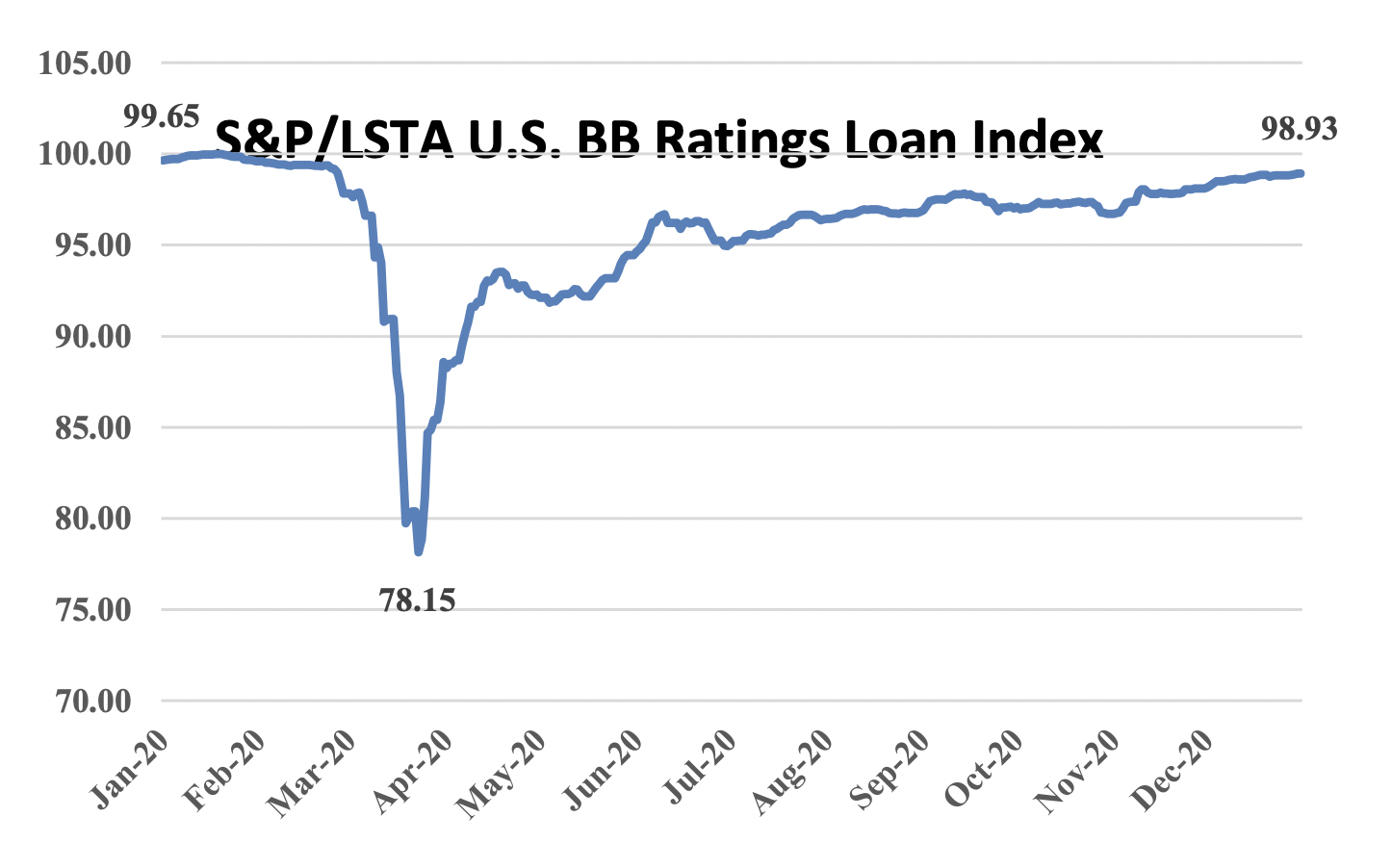
2020 was a year of promise followed by ominous clouds, fear, loss, uncertainty and a splash of optimism. Circling back to see how the Loan Market fared in 2020, it would appear not much has changed. The second half comeback resulted in Fiscal Year 2020 total return of 3.12%, despite losses of as much as 20% in March when the COVID-19 panic and its impact on businesses garnered headlines worldwide.
Volume of $475.5B surpassed 2019 volume of $426B with 28% of the volume coming in January and February from repricing activity. While new money volume returned in the final months of 2020, overall the $213.5B of new money volume trailed 2019’s total of $237.6B. LBO issuance marked a new low since 2013, and M&A issuance a low since 2012. However, total LBO and M&A issuance marked a record month in December, a bright spot leading into 2021.
The S&P/LSTA Leveraged Loan Price Index ended 2020 at 96.19, rebounding from the low of 76.23 on March 23. Lack of new supply and renewed confidence in the economy and underlying asset class drove the price index to return within reach of the 2020 high prior to the Covid-19 pandemic on Jan. 17, 2020 of 97.35. When looking at higher quality names, the S&P/LSTA U.S. BB Ratings Loan Index was at 99.65 to start the year, and ended 2020 at 98.93, within striking distance of pre-pandemic levels.
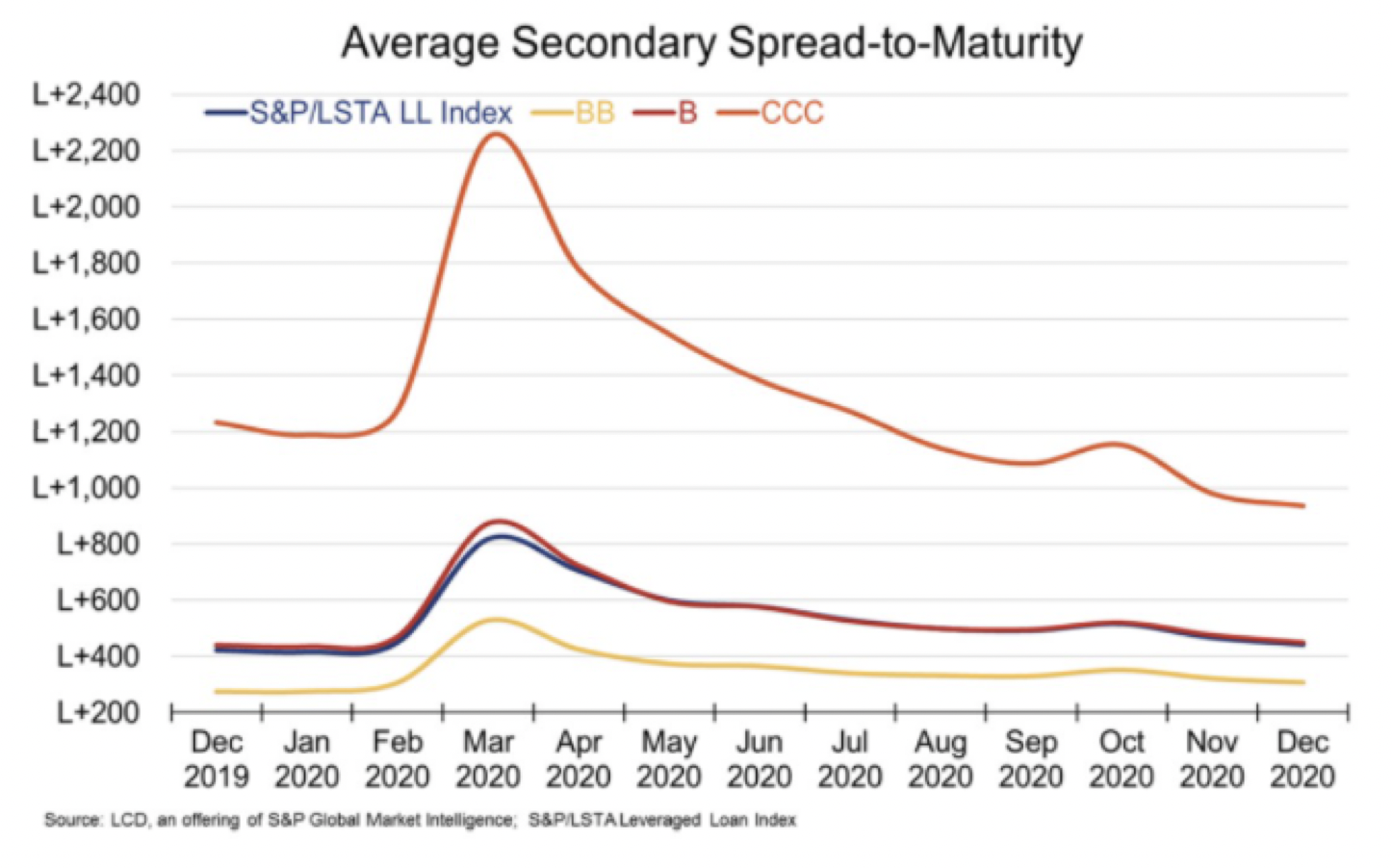
Implied spreads to maturity continued to trend lower heading into 2021 with the S&P/LSTA Leveraged Loan Price Index closing the year at L+443, up from L+421 in 2019. Higher quality loans finished 2020 at L+306, up from L+273 from 2019.
The leveraged loan default rate ended 2020 at 3.83%, almost a full percentage point above its 2.88% historical average. Oil & Gas lead the pack, accounting for 27% of all loan defaults at the end of the fourth quarter. Retail had the second-highest share, at 12%. At 2020's close, risk-gauging sentiments appeared in line with default predictions. The S&P/LSTA Leveraged Loan Index distressed ratio was noted at 4.35%, down sharply from 31.11% in March and the distressed ratio for S&P U.S. High Yield Corporate Bond Index was observed at 5.13% in December 2020, a retreat from March's 34.94%.
2021 Outlook
With the proverbial sun shining on record M&A and LBO volume in December, many arrangers and investors are looking ahead to 2021 with optimism. According to a BofA Global Research report on the 2021 outlook for the loan market, New Money issuance is forecasted to top $300B and gross issuance, including repricings, may be around $380B. Analysts at Barclays Research see U.S. loan supply rebounding from $320B to $340B, with higher year-over-year refinancing in addition to anticipated increases in the M&A and LBO categories. Wells Fargo is also forecasting a rise in 2021, with gross issuance of $350B.
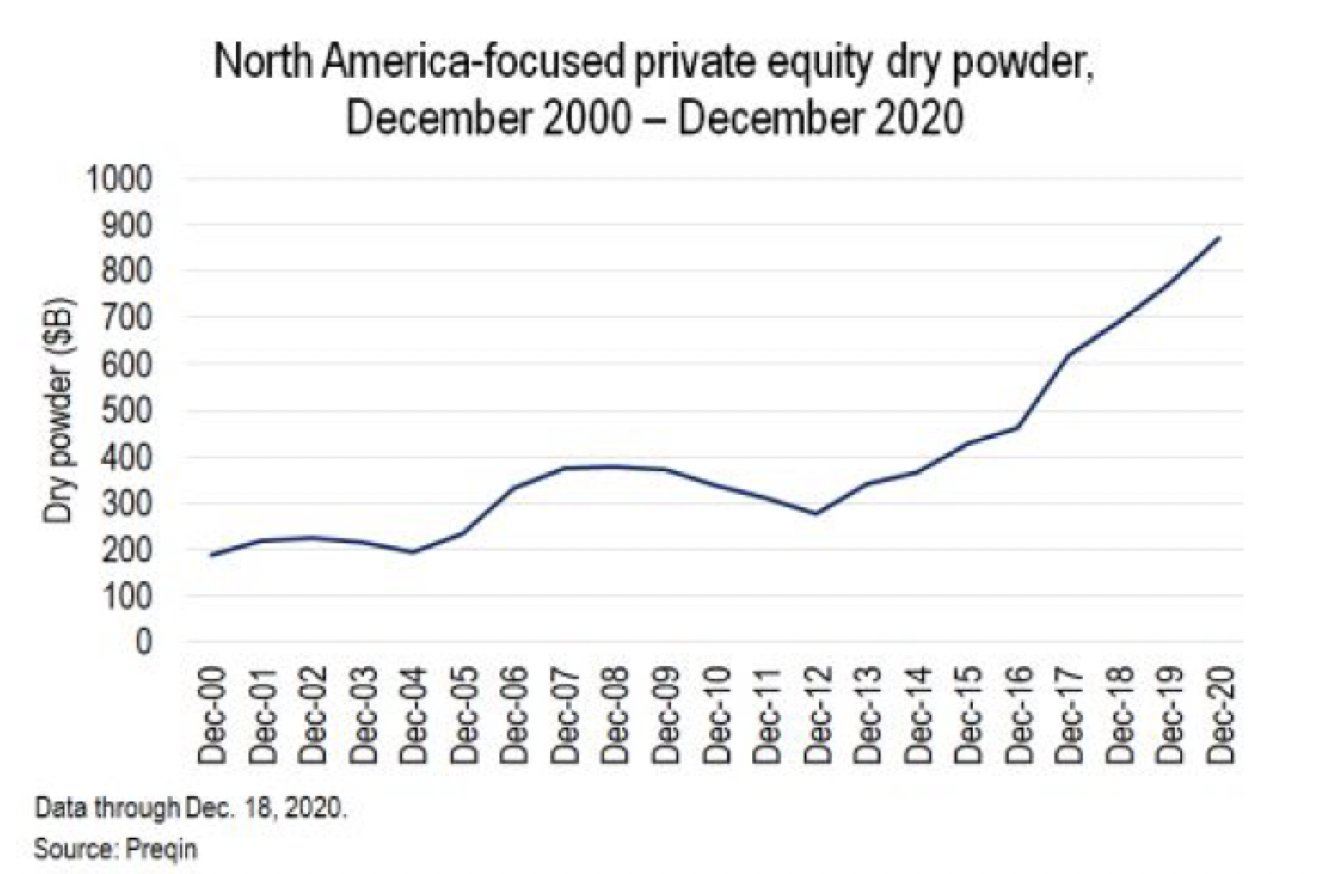
Private equity continues to remain bullish in 2021 as the economy recovers. According to Preqin, North America focused PE Funds dry powder grew to $869.8B from $771.7B in December 2019, providing a catalyst for new money volume M&A and LBO volume.
We continue to see cross market participation between banks and institutional investors in the higher quality names as supply remains tight and demand for loan assets expected to be high. According to the FDIC, as of 3Q 2020, Commercial banks’ loans-to-deposit ratio (“LDR”) were 70%, down from 81% in 3Q 2019, indicating significant bank capital remaining on the sidelines. The average LDR for commercial banks has been 80% since 2016.
Many names are currently back into par-premium territory and some names are difficult to source and aren’t trading, regardless of bid levels. The cross participation between banks and institutional investors has made buying on the secondary much more competitive. Until supply comes to fruition, we’ll continue to see higher quality names grind higher to pre-pandemic levels and start to see higher quality names reprice, shaving 25bps to 50bps on margin. The Broadly Syndicated Loan Market asset class carries short to medium terms, senior secured position relative to bonds and remains liquid should market dynamics warrant a rotation into other industries or asset classes.
The Term Loan A market continues to compete with the bond market’s razor thin yields. Major banks continue to be confident of a resurgence in M&A driven debt, but the Investment Grade forward calendar remains anemic with the TLB market garnering much of the supply.
Diversify Your Loan Portfolio Via The Broadly Syndicated Loan Market
Call us anytime to discuss how to build your loan book and better manage risk through syndicated finance and loan sales and participations.
Joe Siegel
Managing Director
jsiegel@enduranceadvisory.com
Cell: 469-236-5042
LinkedIn Profile
Todd Helman
Director
thelman@enduranceadvisory.com
Cell: 301-379-5777
LinkedIn Profile
Disclaimer
This presentation is being furnished on a confidential basis to provide preliminary summary information. The information, tools and material (collectively, information) contained herein is not directed to or intended for distribution or use by any person or entity who is a citizen or resident of or located in any jurisdiction where such distribution, publication, availability or use would be contrary to law or regulation or which would subject Endurance Advisory, LLC, to any registration or licensing requirement within such jurisdiction.
The information presented herein is provided for informational purposes only and is not to be used or considered as an offer to sell, or buy securities or other financial instruments, or any advice or recommendation with respect to such securities or other financial instruments. The information may not be reproduced in whole or in part or otherwise made available without the prior written consent of Endurance Advisory, LLC. Information and opinions presented have been obtained or derived from sources believed to be reliable, but Endurance Advisory, LLC makes no representation as to their accuracy or completeness. Endurance Advisory, LLC, accepts no liability for any loss arising from the use of the information contained herein.
This information is subject to periodic update and revision. Materials should only be considered current as of the date of the initial publication, without regard to the date on which you may access the information. Endurance Advisory, LLC, maintains the right to delete or modify the information without prior notice.
Under no circumstances and under no theory of law, tort, contract, strict liability or otherwise, shall Endurance Advisory, LLC be liable to anyone for any damages resulting from access or use of, or inability to access or use, this information regardless of whether they are dire, indirect, special, incidental, or consequential damages of any character, including damages for trading losses or lost profits, or for any claim or demand by any third party, even if Endurance Advisory, LLC knew or had reason to know of the possibility of such damages, claim or demand.