
How the AI Infrastructure Buildout Is Reshaping Global Capital, Construction, and the Communities in Between
I want to start with several moments that happened within a few weeks of each other, because together they frame everything that follows. The digital revolution is often described in ethereal terms, the "cloud," "virtual" reality, and "seamless" data. However, standing in the heart of Texas in early 2026, the abstraction of the internet vanishes. In its place stands concrete, steel, and immense heat.
The first moment was a walkthrough of DataBank’s 16-acre campus in Plano, Texas. It is an impressive facility, with dual feeds from a dedicated Oncor substation. Forty megawatts of power flow into a single site enough to supply roughly 30,000 homes. The cooling infrastructure runs constantly, creating a sound louder than you expect, somewhere between a turboprop engine and a machine shop floor. It is, in every physical sense, critical infrastructure. And standing in the middle of it, what struck me was not the scale. It was the permanence.
The second was a drive past the Stargate One campus outside Abilene with Eric Bruntmeyer, President of Hardin Simmons University. We were on our way to a university luncheon where I’d originally been asked to speak about banking. Eric had pivoted the topic in the days before - from banking to how AI and digital assets are reshaping financial services, healthcare, and the infrastructure of daily life. He had read the room correctly.
The topics were not about GPU clusters or private credit. They were about traffic on residential streets. They were about who benefits and how this would impact their lives. Will AI take a lot of jobs? Why are leaders optimistic about AI, and are they wrong to be? What is it, exactly? Then cryptocurrency, is it different than a credit card transaction? Does Bitcoin have an intrinsic value?
Those are the right questions. And they deserve better answers than this industry has typically offered. What follows is my attempt to connect the institutional story, the capital, the construction, the engineering with the human one. Because the $2.9 trillion being deployed over the next four years is not an abstraction. It is happening in specific places, to specific communities, and the people in those places deserve to understand what they’re part of.
I. Where the Capital Is Coming From: $2.9 Trillion by 2028
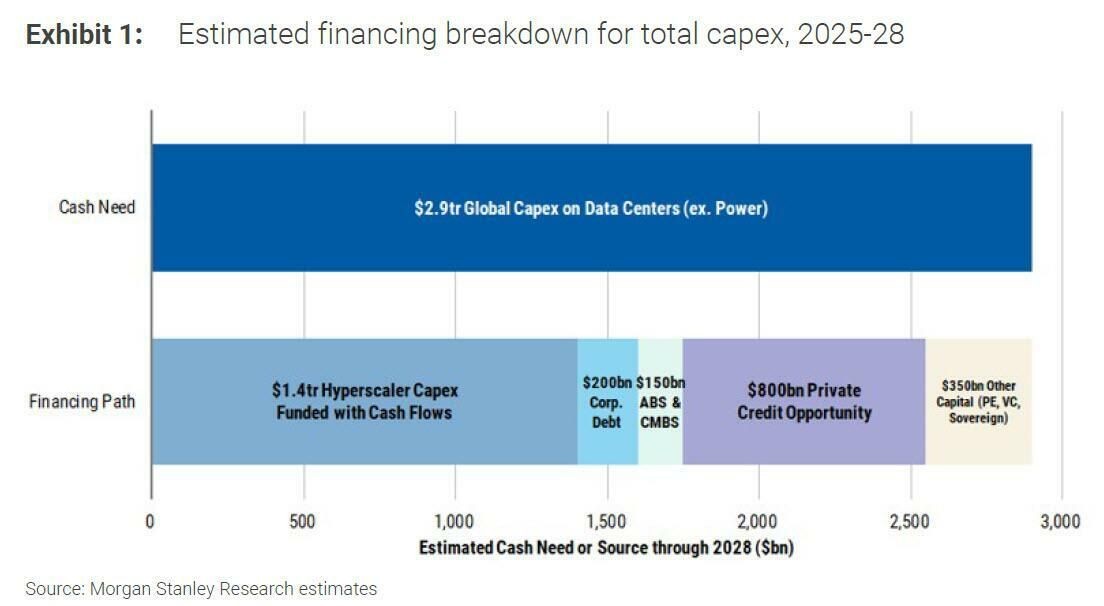
Morgan Stanley estimates that global data center capital expenditure excluding power infrastructure will reach $2.9 trillion between 2025 and 2028. That figure is large enough to dwarf most sovereign infrastructure budgets, and the financing structure behind it is unlike anything the commercial real estate or infrastructure debt markets have previously absorbed.
The breakdown tells an important story about who is bearing risk and how. Approximately $1.4 trillion is funded directly from hyperscaler operating cash flows. Amazon, Microsoft, Google, and Meta are effectively self-financing the majority of the buildout from operations, bypassing the traditional bottlenecks of the banking system.
However, the real institutional story lies in the $800 billion in private credit. This is the single most significant institutional opportunity in the stack. To put that in perspective, the private credit opportunity in data centers today is larger than the entire U.S. leveraged loan market was a decade ago. For institutional lenders, this cycle represents a structural expansion. Data center loans share characteristics with both infrastructure debt, long-term contracted cash flows and commercial real estate, site-specific assets. Neither category fully captures the risk profile, which is part of why underwriting standards and documentation practices are still evolving rapidly.
The ABS (Asset-Backed Securities) and CMBS activity is also worth watching. Early transactions have priced well, but the collateral pool is relatively shallow. As deal volume grows, rating methodology and covenant structures will be tested in ways the market has not yet experienced, particularly as the rapid pace of AI innovation threatens to make older facilities obsolete.
II. Construction at the Crossover Point
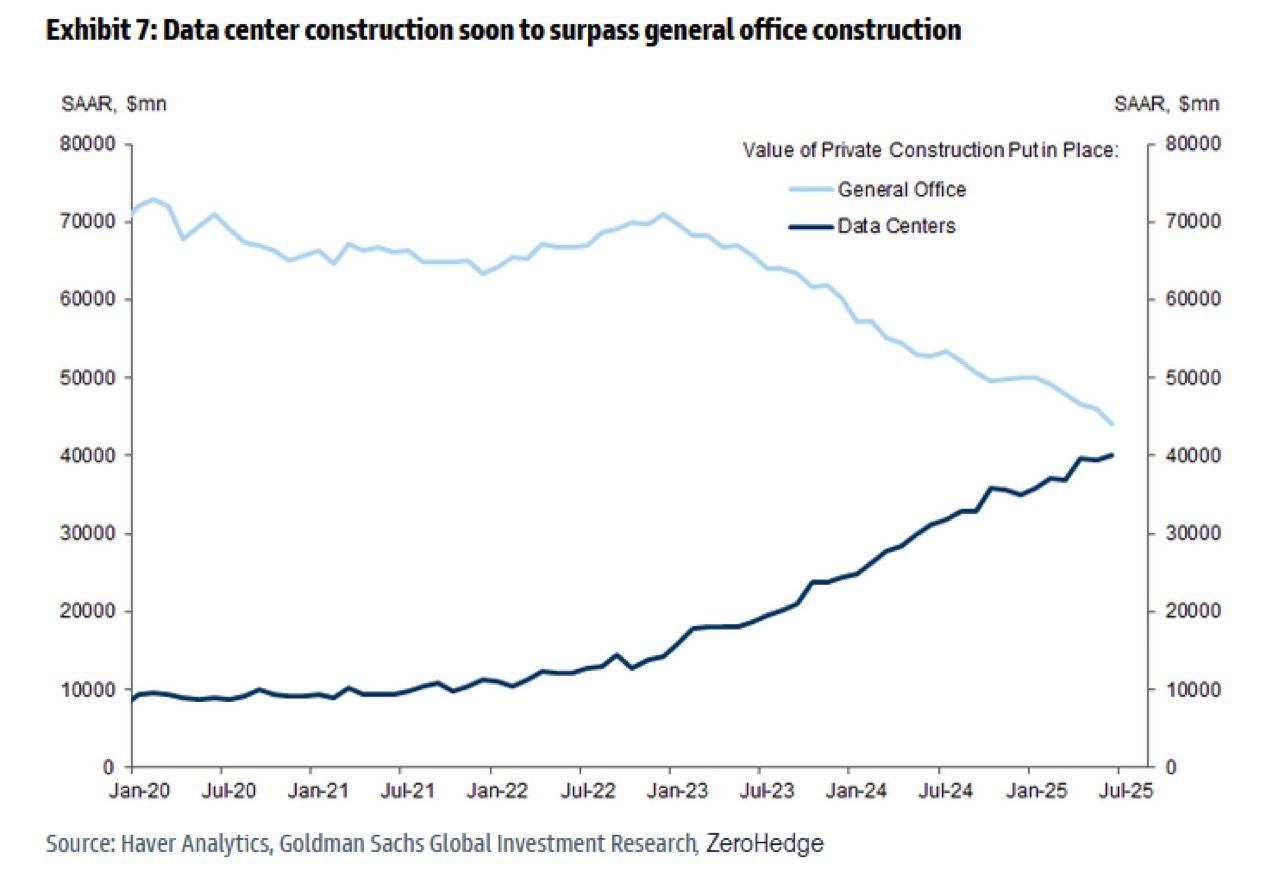
Goldman Sachs data shows data center construction spending rising from approximately $10 billion annualized in early 2020 to over $40 billion by mid-2025. Over the same period, general office construction has declined from roughly $72 billion to under $45 billion. The lines are about to cross.
That crossover is more than a chart pattern. It is a reallocation of the construction industry’s labor, materials, and logistics capacity toward a new category of demand. Having seen both the DataBank campus in Plano and the scale of what’s underway in Abilene, I can tell you that the numbers on the page understate the physical reality.
Consider the scale of labor. A major data center campus in 2018 might have employed 750 construction workers at peak. The Stargate One campus in Abilene currently has approximately 9,000 craft workers on-site every day. That is not a rounding error, it is a different category of industrial activity. The supply chain implications run deep. Electrical switchgear and high-voltage transformers face lead times measured in years, not months. Procurement strategy has become as important as construction scheduling; several large projects have experienced delays not from permitting or financing, but from simple equipment availability.
III. The Geographic Distribution of Digital Infrastructure
As of February 2026, there are 10,807 data centers globally. The United States accounts for 3,960, approximately 37% of the worldwide total. That concentration reflects both the geographic origin of hyperscale cloud infrastructure and the depth of U.S. capital markets, but it is increasingly also a matter of deliberate national strategy.
The remainder of the top five: United Kingdom (498), Germany (470), China (365), and France (335). The China figure deserves attention. Despite the country’s ambitions in AI and manufacturing, it trails smaller European nations in data center count by a meaningful margin. Regulatory structure and the deliberate bifurcation of global cloud ecosystems contribute to that gap.
U.S. dominance in data center density is not merely a market share story. It is a geopolitical asset and one that national policy is increasingly designed to protect. When Lancium’s CEO briefed Abilene city leaders this week, he mentioned a White House visit where AI infrastructure was framed explicitly as a national security issue, not just an economic one. That framing changes the conversation about why these projects happen where they do.
IV. How AI Is Rewriting the Engineering Specification
The DataBank campus I walked in Plano was built to a specification that is already being superseded. Traditional enterprise data centers were designed around power densities of roughly 5 to 10 kilowatts per rack. AI training and inference workloads push that figure to 50 to 100 kilowatts per rack and next-generation GPU clusters are beginning to exceed even that.
This is a fundamental re-engineering of four interconnected systems. First, thermal management: Air cooling cannot efficiently handle 100 kW rack densities. Direct liquid cooling, cold plates and immersion systems is transitioning from niche to standard. The plumbing alone adds meaningful cost and complexity. Second, power infrastructure: Higher densities require more robust distribution at every level. Third, networking: AI training requires massive data transfers at bandwidths measured in terabits per second. Finally, acoustics: The combination of high-density compute and intensive cooling creates sound environments that exceed what conventional facilities management was designed to address.
The consequence is that a significant portion of existing capacity is functionally obsolete for the highest-value workloads. Operators must choose: retrofit, which is expensive and physically constrained, or build new. The Stargate One project in Abilene is the latter designed from the ground up for AI-density compute, using liquid cooling in a closed-loop system that fills once and recirculates with minimal ongoing water consumption.
V. When the Buildout Comes to Your Town
Driving past the Stargate One site on the north side of Abilene, you see what a 4-million-square-foot construction project looks like from a car window. It is vast. It is industrial. And for the people who live nearby, it arrived faster than their understanding of what it is.
The project is a partnership between Lancium, which owns the land and power infrastructure, and Crusoe, which built and operates the data center. Oracle is the end customer. But the scale of what has materialized the 9,000 workers, the construction running through early 2027 has prompted community questions that no press release fully answers. Local officials describe it as the largest single economic investment in Abilene since Dyess Air Force Base. The economic development story is real. But the gap between that story and what residents are experiencing, traffic, noise, industrial activity is a communications problem as much as a policy one.
The luncheon audience I spoke to in Abilene was not hostile; they were uninformed. That is a solvable problem. The questions I fielded were grounded and practical: What does this mean for local healthcare? Will the jobs go to people from Abilene? The water issue, which surfaces in every community, has a specific and reassuring answer here: the closed-loop system avoids drawing continuously from local aquifers. This technical answer builds trust, but only if it is communicated proactively, before the question becomes a grievance.
VI. The Risks the Charts Do Not Show
The numbers are compelling, but several dynamics deserve consideration. Energy constraint is the binding variable. Power availability, not financing, is the most common bottleneck. Utility interconnection queues in Northern Virginia and Silicon Valley now extend three to five years. Lancium’s presence in Abilene since 2020 securing land and utility relationships years before the announcement, is exactly the kind of positioning required.
Regulatory risk is also underpriced. Zoning, water use restrictions, and community opposition are creating friction. Ireland and the Netherlands have already seen informal caps on new approvals. Furthermore, demand concentration creates vulnerability. A meaningful shift in AI investment appetite would ripple through the supply chain faster than most participants currently model. Finally, talent scarcity is structural; the industry is competing for a finite pool of electrical engineers and project managers across a dramatically expanded pipeline of projects.
VII. FermiAmerica and the Private Grid Bet
Before they closed their financing, we had conversations with the FermiAmerica team about what a project of this ambition would require. FermiAmerica’s Project Matador in Amarillo, Texas, is arguably the most ambitious private infrastructure project in the country. The vision: an 11-gigawatt private HyperGrid campus spanning 7,570 acres, integrating natural gas, solar, battery storage, and eventually advanced nuclear.
What the team understood early is that if you want to build AI infrastructure at scale, you need to bring your own power. They found the answer. In February 2026 alone, FermiAmerica closed over $600 million in institutional equipment commitments. A $500 million equipment loan from MUFG Bank funds the acquisition of Siemens Energy gas turbines, while a $200 million facility arranged by Cape Commercial Finance finances the procurement of utility-grade breakers and transformers.
The "warehouse strategy" they've employed is a financing innovation. In a market where transformer lead times stretch to three years, the ability to pre-finance equipment procurement and then recycle that capital into permanent financing is a massive competitive moat. They built while the market was still deciding. Their partnership with the Texas Tech University System also anchors the project in the community, connecting a cutting-edge build to an institution with deep regional roots.
Conclusion: Partners, Not Bystanders
I have spent time in Plano, Abilene, and Amarillo. I have spoken to rooms of people who want to understand what is happening in their backyard. I keep coming back to the same observation: this buildout is both larger and more human than the institutional narrative suggests.
It is $2.9 trillion in capital formation, but it is also 9,000 workers showing up in Abilene every morning. It is a university president pivoting an agenda because he knew his community needed to hear something different. The opportunity is generational, but the execution window is not. The communities absorbing this transformation deserve to be partners in it, not bystanders to it.
The $2.9 trillion will be deployed whether or not any single community buys in. But the projects that earn genuine local trust through specific answers about power, water, and jobs will operate more sustainably and deliver more durable returns. That is not a social responsibility argument. It is an execution argument.